Quick answer
Quick answer
Digestive enzyme supplements can cause stomach side effects: Cleveland Clinic lists constipation, nausea, stomach cramps and diarrhea. A Mayo Clinic expert says the risks of most over-the-counter enzymes are "pretty minimal" unless you take "super-high doses." No source we found studied years of daily use, and Johns Hopkins Medicine says their side effects are unknown. Pregnant, or on medicine? Ask a provider first.
What are the side effects of digestive enzymes?
Mostly stomach symptoms. None of the sources gives a rate, and each row keeps its source's scope: enzyme supplements in general, one enzyme (bromelain), or all supplements.
| Effect | What the source says (its scope) | Who should ask a doctor first | Source |
|---|---|---|---|
| Stomach upset or irritation | "Some people get gastrointestinal upset or some irritation." Said of over-the-counter enzymes, with risks called "pretty minimal" unless doses are super-high | Anyone whose symptoms do not settle | Mayo Clinic |
| Constipation, nausea, stomach cramps, diarrhea | Listed as symptoms you may have if you take a digestive enzyme supplement. No rate or time frame is given | Anyone whose symptoms last or get worse | Cleveland Clinic |
| Stomach upset and diarrhea (bromelain) | Taken by mouth, bromelain "seems to be well tolerated"; stomach upset and diarrhea are the side effects reported most often. This is bromelain on its own, one enzyme found in some blends | Anyone who takes a medicine | NCCIH |
| Bleeding, with blood thinners (bromelain) | Bromelain may have anti-platelet activity, so for people taking blood thinners "theoretically there could be increased risk of bleeding" | Anyone on a blood thinner | Mayo Clinic |
| Interactions with medicines | FDA says of supplements in general that "some supplements can interact with medications"; NCCIH adds, for bromelain, that some herbs and medicines interact in harmful ways | Anyone on a prescription medicine | FDA; NCCIH |
| Itching, rash, hives, swelling, wheezing | On FDA's list of serious reactions to dietary supplements in general, not to enzymes in particular | Anyone with a known allergy, before starting; anyone with these signs, at once | FDA |
| Effects nobody has measured | For over-the-counter enzyme supplements, dosage, ingredients and enzyme concentration are not assured, and side effects are unknown | Everyone: tell your provider what you take | Johns Hopkins Medicine |
Sources: Cleveland Clinic, Mayo Clinic, NCCIH, FDA and Johns Hopkins Medicine, linked below. A row is what one source says, not a rate for any product.
If a new symptom starts the week you add an enzyme, note the date in a food diary for bloating, so the supplement and your meals can be told apart.
Is it safe to take digestive enzymes every day?
No source we found tested years of daily use of an over-the-counter enzyme, so long-term safety is a gap in the evidence we found. What the sources offer is a way to try one carefully.
Brent Bauer, MD, of Mayo Clinic, co-wrote a 2014 review on over-the-counter enzymes for clinicians. He calls the risks pretty minimal for most of them at ordinary doses, and uses a short trial with patients: two or three weeks, then a decision.
"If it's not working, don't just keep taking more and hoping for something magical to happen."
FDA's general advice for every dietary supplement points the same way: take only what the label describes, because some ingredients can be harmful in high amounts, over a long time, or with certain drugs or foods. Harvard Health adds that for most people there is little evidence these supplements help at all. What two small enzyme trials did measure is set out in do digestive enzymes help with bloating?
Does taking digestive enzymes stop your body making its own?
No source we found studied it. None of the nine outside sources on this page tested whether an enzyme supplement changes how much of its own enzyme the body makes, in the short term or after years.
What the sources do describe is the body's own supply. Your stomach, small intestine and pancreas all make digestive enzymes, Johns Hopkins Medicine says, and it calls the pancreas the enzyme "powerhouse." Cleveland Clinic's gastroenterology article adds that in most cases you don't need to worry about your body making enough.
If this question decides whether you take an enzyme for months, put it to your doctor. A real shortage is a medical finding, and the answer to it is a prescription product from a doctor, not a store shelf.
How much is too much? Taking more than the label says
The dose on the label is the limit to keep to. Sources tie the risk to the amount: Mayo Clinic's expert says the risks stay low "unless you're taking super-high doses."
Counting what you take is harder than it sounds. Cleveland Clinic notes that it can be hard to determine how much of each enzyme is really in a given supplement, and Johns Hopkins Medicine says enzyme concentration is not assured. Two capsules of one product may not equal two of another.
Over-the-counter enzymes vs prescription enzyme medicine
They are different products. A prescription enzyme is a medicine a doctor prescribes and doses; an over-the-counter enzyme is a dietary supplement that FDA does not approve before it is sold.
| Question | Prescription enzyme medicine | Over-the-counter enzyme supplement |
|---|---|---|
| What it is | Pancreatic enzyme replacement therapy (PERT), "a medication your doctor prescribes" (Johns Hopkins) | A dietary supplement; these products "are not medications" (Harvard Health) |
| Approved before sale? | Hopkins calls PERT the only FDA-regulated enzyme replacement therapy | No: FDA does not approve dietary supplements for safety and effectiveness before they are sold (FDA) |
| Who sets the dose | The prescriber; doses can be adjusted for each person's clinical needs (Cleveland Clinic) | The label; take only as it describes (FDA) |
| What is in it | Amylase, lipase and protease (Johns Hopkins) | Often amylase, lipase and protease; some add lactase and alpha-galactosidase. Amounts are not assured (Johns Hopkins) |
| Who it is for | People whose bodies do not make or release enough enzymes, a diagnosis a doctor makes (Johns Hopkins; Mayo Clinic) | Sold over the counter; Hopkins notes many people take them for problems such as gas, bloating and diarrhea |
Which over-the-counter products are drugs and which are supplements, simethicone included, is laid out in over-the-counter bloating relief.
Who should check with a doctor before taking digestive enzymes?
Anyone pregnant or breastfeeding, seriously ill, with a weakened immune system, on a prescription medicine or a blood thinner, or with a known allergy. Physician's Choice words two of these checks this way:
- If you are pregnant or breastfeeding, are seriously ill, or have a weakened immune system, consult your healthcare provider before taking a probiotic or any other dietary supplement.
- If you have known allergies, review the product's ingredient list and allergen information and consult your healthcare provider before purchasing or using it. Most of our products are formulated without the top 9 common allergens, but ingredients vary by product.
The outside sources add two more. Mayo Clinic's expert flags blood thinners because of bromelain, and NCCIH says that if you take any type of medicine, you should talk with your health care provider before using bromelain. NCCIH also notes that little is known about bromelain's safety during pregnancy or breastfeeding.
Where Physician's Choice fits
Physician's Choice, which publishes this site, makes Digestive Enzymes, a dietary supplement that none of the sources on this page tested. Its enzyme list is printed below as the label prints it.
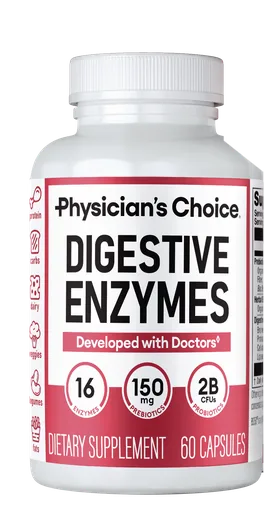
What the Digestive Enzymes label and product page list
Digestive Enzymes is a broad-spectrum blend designed to be taken with meals to help break down proteins, fats, dairy, and carbohydrates.‡
- Serving
- 1 capsule per serving; 60 per bottle (60 count)
- Enzyme blend
- 85 mg, 16 enzymesBromelain, amylase, protease 4.5, glucoamylase, protease 6.0, papain, lactase, protease 3.0, peptidase, cellulase, beta-glucanase, alpha-galactosidase, lipase, xylanase, hemicellulase, invertase
- Prebiotic and probiotic blend
- 159 mg: organic inulin (Jerusalem artichoke), organic acacia fiber, inulin (chicory), B. subtilis OPTIBIOME BS50, B. coagulans, B. clausii
- Directions
- 1 capsule with the largest meal; some take an extra one with heavy meals, and most do not go above 2 a day
- Shelf life
- About 2 years from manufacture; the date is on the bottom of the bottle
Checked against the 60 count label and the product page on Oct 12, 2026.
Because the blend carries fiber, Physician's Choice also says: "Our 60 Billion Probiotic and Digestive Enzymes contain inulin, and our Fiber Gummies contain chicory root fiber; gut bacteria break down fibers like these, which can cause gas." Which enzyme matches which food is in what supplement helps with gas and bloating after eating.
When should you stop and get help?
Page history
| Date | Step | What we did |
|---|---|---|
| Sep 5 to Oct 5, 2026 | Shopper words | Of 1,031 public Reddit posts from 228 communities, 3 mentioned digestive enzymes, and none asked about side effects or daily use. |
| Oct 12, 2026 | The question | "Digestive enzymes side effects", with the follow-ups searchers add: are they safe, every day, during pregnancy, and what too much does. |
| Oct 12, 2026 | Sources | Opened 8 outside pages, from Cleveland Clinic, Mayo Clinic, Johns Hopkins Medicine, Harvard Health, NCCIH, NIDDK and FDA, plus one PubMed record. Quotes are copied from each page. |
| Oct 12, 2026 | Label | Checked six Digestive Enzymes lines against the label and product page. The line marked ‡ and the four quoted Physician's Choice lines are wording the company approved. |
| Oct 12, 2026 | Published | Live on the site, written by the Physician's Choice editorial team. |
Short answers
Is it safe to take digestive enzymes every day?
No source we found tested years of daily use. A Mayo Clinic expert calls the risks of most over-the-counter enzymes pretty minimal unless doses are super-high, and suggests a trial of two or three weeks. FDA warns that some supplement ingredients can be harmful when taken for a long time, so follow the label and tell your provider.
Are digestive enzymes safe during pregnancy?
No source here studied enzyme blends in pregnancy. NCCIH says little is known about whether bromelain, one enzyme used in some blends, is safe during pregnancy or breastfeeding. Physician's Choice advises: "If you are pregnant or breastfeeding, are seriously ill, or have a weakened immune system, consult your healthcare provider before taking a probiotic or any other dietary supplement."
What happens if you take too many digestive enzymes?
Sources tie the risk to the dose. A Mayo Clinic expert says the risks are pretty minimal unless you take super-high doses, and advises against taking more when an enzyme is not helping. Cleveland Clinic lists constipation, nausea, stomach cramps and diarrhea as possible symptoms. Stay at the amount on the label.
Can digestive enzymes cause constipation or diarrhea?
They can. Both are on Cleveland Clinic's list of symptoms you may have with a digestive enzyme supplement, along with nausea and stomach cramps, and NCCIH names stomach upset and diarrhea as the most commonly reported side effects of bromelain. If either lasts or gets worse, stop and get medical advice.
More answers on this site
- How long does bloating last? What ends it, cause by cause, and when to see a doctorHow long each cause lasts, and what ends it.
- Do digestive enzymes help with bloating? What studies tested, and what is still unknownWhat the enzyme trials measured, and their size.
- What supplement helps with gas and bloating after eating?The enzyme that matches each food.
- Over-the-counter bloating relief: what each option doesWhich shelf products are drugs and which are supplements.
- How to keep a food diary for bloating: what to log and how to read itLog a new supplement next to your meals.
- What causes bloating? Common causes and the clue for eachCauses an enzyme does not touch.
Sources
- Cleveland Clinic Health Essentials: Digestive enzymes 101, why they're importantWith gastroenterologist Alison Schneider, MD. September 5, 2025. Opened Oct 12, 2026.
- Mayo Clinic News Network: Should you add enzyme supplements to your shopping list? Mayo expert explains pros and consWith Brent Bauer, MD. August 4, 2014. Opened Oct 12, 2026.
- Edakkanambeth Varayil J, Bauer BA, Hurt RT. Over-the-counter enzyme supplements: what a clinician needs to know.Mayo Clin Proc. 2014;89(9):1307-12. PMID 25103998. Opened Oct 12, 2026.
- Johns Hopkins Medicine: Digestive enzymes and digestive enzyme supplementsWith Morgan Denhard, MS, RD, LDN. Opened Oct 12, 2026.
- Harvard Health Publishing: Can taking enzyme supplements help soothe my bloating?November 1, 2022. Opened Oct 12, 2026.
- NCCIH: Bromelain, usefulness and safetyLast updated November 2024. Opened Oct 12, 2026.
- FDA: FDA 101, Dietary SupplementsContent current as of 06/02/2022. Opened Oct 12, 2026.
- FDA: How to report a problem with dietary supplementsContent current as of 03/13/2025. Opened Oct 12, 2026.
- NIDDK: Symptoms and causes of gas in the digestive tractLast reviewed June 2021. Opened Oct 12, 2026.
- Physician's Choice: Digestive Enzymes product page and Supplement Facts panelLabel facts checked Oct 12, 2026.