Quick answer
Quick answer
Write down every food and drink with the time and amount, then each symptom, when it started and how strong it felt. NIDDK says a doctor may ask you to keep this kind of diary, and that it may show specific foods and drinks that are causing gas. Then look for repeats: dairy, beans, cruciferous vegetables, fizzy drinks and "-ol" sweeteners are on NIDDK's lists.
What should a food diary for bloating include?
Seven columns: time, what you ate and drank, amount, symptoms, when they started, how strong they were, and notes. NIDDK asks for the foods, the drinks and the timing of symptoms; the other columns make a pattern easier to spot.
| Time | What you ate and drank | Amount | Symptoms | When they started | How strong (0 to 3) | Notes |
|---|---|---|---|---|---|---|
| 8:00 amExample | Oatmeal made with milk; coffee | 1 bowl; 1 mug | Bloating | 10:30 am | 1 | Ate at my desk, fast |
| 1:00 pmExample | Lentil soup; sparkling water | 2 cups; 1 can | Gas, bloating | 4:00 pm | 2 | Eased after a walk |
| Blank row | ||||||
| Blank row | ||||||
| Blank row |
Columns from NIDDK and Cleveland Clinic. The 0 to 3 scale is this page's, not a clinical score: 0 none, 1 mild, 2 bothersome, 3 strong. The example rows are made up to show the format.
Why the amount column matters. NIDDK says lactose intolerance symptoms can be mild or severe depending on how much lactose you have. The same question comes up in public posts:
"I've been trying to figure out whether it's chickpeas themselves or just the amount I'm eating."
Public Reddit post, r/GutHealth, Sep 2026. Shown as a question, not a review.
What goes in the notes. Cleveland Clinic's nurse practitioner Bryn DeSantis suggests what you were doing when symptoms started and what, if anything, made them better. NIDDK adds the medicines and supplements you take.
"I typically recommend keeping a food journal and recording everything you eat and drink for a few days."
How long should you keep a bloating food journal?
No source we checked sets a length. Cleveland Clinic's nurse practitioner says a few days; this page reads entries over two weeks, so that a food you eat often shows up more than once. That length is our choice, not a source's.
Timing is the reason to keep writing after meals end. The NHS says food intolerance symptoms usually start a few hours after the food and can last for a few hours or days, and NIDDK says lactose intolerance symptoms may start within a few hours of milk products. A symptom at 9 pm may belong to lunch, so log symptoms into the evening and the next morning, not only right after you eat. How long each kind of bloating tends to last once it starts is set out, cause by cause, in how long does bloating last?
Causes other than food, such as constipation, are in our guide to what causes bloating.
How do you find what foods make you bloated? Reading two weeks of entries
Look for a symptom that follows the same food more than once, after a similar delay. Each row below takes one pattern, what a source says it can point to, and what that source suggests trying.
| Pattern in your diary | What a source says it can point to | What to try, per the source | Source |
|---|---|---|---|
| Symptoms a few hours after milk, ice cream or yogurt, worse with more | Lactose, the sugar in milk; symptoms may be mild or severe depending on how much lactose you have | Small amounts of milk at a time, with meals; yogurt and hard cheeses, which are lower in lactose; lactase products. A doctor may ask you to stop milk products for a while to see if symptoms go away | NIDDK |
| Gas after beans, lentils, cabbage, onions or garlic | Foods that can produce gas (MedlinePlus); the gas forms when bacteria in the large intestine break down carbohydrates the small intestine did not fully digest (NIDDK) | Lower your intake of beans, cabbage, onions, garlic and Brussels sprouts | NIDDK; MedlinePlus |
| After apples, pears, fruit juice, soft drinks or sports drinks | Fruits, juices and drinks with high-fructose corn syrup are on NIDDK's list of carbohydrates that may lead to excess gas | Stay away from foods with high levels of fructose or sorbitol | NIDDK; MedlinePlus |
| After sugar-free gum, candy or drinks | Sweeteners ending in "-ol": sorbitol, mannitol, xylitol, erythritol and maltitol | Do not chew gum, and limit candy made with sugar substitutes | NIDDK; MedlinePlus |
| Burping and fullness during the meal, with gum, fizzy drinks, straws or fast eating | Swallowed air | Eat slowly, sitting down; limit gum, hard candy, fizzy drinks and straws; avoid talking while eating | NIDDK |
| Began in the week you added more fiber | Some people have more gas symptoms when they consume too much fiber; the gas can be temporary | Note the date you added it; the body may adjust and stop producing the extra gas over time | NIDDK; MedlinePlus |
| After large or high-fat meals, whatever the food | Meal size; high-fat foods can increase bloating for some people | Smaller, more frequent meals instead of larger ones; talk with your doctor or a dietitian about your diet | NIDDK |
| No food lines up, or bloating most days | A doctor can use the diary to tell extra gas apart from a gut that is more sensitive to normal amounts | Take the diary to a provider, especially if home steps have not helped | NIDDK; Cleveland Clinic |
Sources: NIDDK, MedlinePlus and Cleveland Clinic, linked below. A pattern is a lead for you and your doctor to follow up, not a diagnosis.
Testing a suspect food is a job to share with a professional: the NHS describes dietitian-led diets that drop the food, then bring it back after a few weeks to see whether symptoms return. If gas is the symptom your diary keeps showing, the part of each food that makes it is named in why am I so gassy?
Should you cut out a food once the diary points to it?
Cut back, yes; cut out a whole food group, not on your own. MedlinePlus suggests watching for foods that trigger your bloating so you can start to avoid them. For whole groups, the NHS adds a caution:
"But it's important to not cut foods out of your or your child's diet without the advice of a GP or food and nutrition specialist (dietitian)."
Dairy shows why. NIDDK notes that most people with lactose intolerance can have some lactose without symptoms, that research suggests many could have 12 grams, about the amount in 1 cup of milk, with no or only mild symptoms, and that avoiding all milk and milk products may leave you short of calcium and vitamin D. The NHS adds that some home intolerance tests are not recommended.
What to take to the doctor: the questions your diary answers
MedlinePlus lists the questions a provider may ask about gas. Two weeks of entries answer most of them before you sit down.
| The provider may ask | Where it is in your diary |
|---|---|
| What foods do you commonly eat? Has your diet changed recently? | What you ate and drank, week one against week two |
| Have you increased the fiber in your diet? | Notes, with the date you started |
| How fast do you eat, chew, and swallow? | Notes: what you were doing |
| Would you say that your gas is mild or severe? | The 0 to 3 column |
| Does your gas seem to be related to eating milk products or other specific foods? | The patterns you found with the table above |
| What seems to make your gas better? What medicines do you take? | Notes |
"The diary can help your doctor or dietitian figure out whether certain foods and drinks could be causing your gas symptoms."
Where Physician's Choice fits
Physician's Choice, which publishes this site, makes Digestive Enzymes. It words the match between an enzyme and a food this way:
For occasional gas and bloating after meals, choose a digestive enzyme that helps break down the food components that may be causing discomfort: lactase for lactose in dairy, or alpha-galactosidase for certain carbohydrates in foods like beans, lentils, broccoli, and cabbage.‡
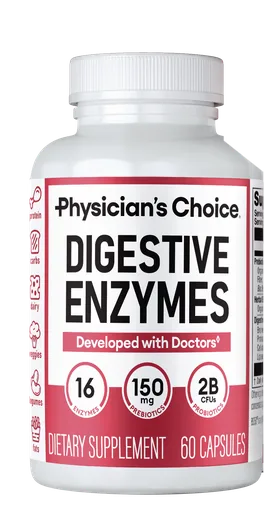
Digestive Enzymes, from the label and product page
Digestive Enzymes is a broad-spectrum blend designed to be taken with meals to help break down proteins, fats, dairy, and carbohydrates.‡
- Serving
- 1 capsule per serving; 60 servings in the 60 count bottle
- Enzyme blend
- 85 mg of 16 enzymes, among them lactase and alpha-galactosidase
- Directions
- 1 capsule with your largest meal; some people take one more with heavy meals, and most take no more than 2 a day
Checked against the 60 count label and the product page on Oct 10, 2026. None of the sources on this page tested it. If you start it, or any supplement, write it in the notes column: NIDDK lists supplements among the things a doctor asks about. What sources say about enzyme side effects is in digestive enzymes side effects.
Enzyme by food: what supplement helps with gas and bloating after eating. What trials measured: do digestive enzymes help with bloating? Drugs on the shelf: over-the-counter bloating relief.
When should the diary go to a doctor sooner?
Page history
| Date | Step | What we did |
|---|---|---|
| Sep 5 to Oct 5, 2026 | Shopper words | Of 1,031 public Reddit posts from 228 communities, 379 were about bloating and 225 about gas. One person asked whether the trouble was chickpeas or the amount. |
| Oct 10, 2026 | The question | "Food diary for bloating", with the questions searchers ask next: what to write, for how long, and how to find the foods involved. |
| Oct 10, 2026 | Sources | Read 10 pages from NIDDK, MedlinePlus, Cleveland Clinic and the NHS; quotes are copied from the pages as they read that day. |
| Oct 10, 2026 | Label | Checked three Digestive Enzymes lines against the label and product page. The two lines marked with ‡ are wording Physician's Choice approved. |
| Oct 10, 2026 | Published | First version live, from the Physician's Choice editorial team. |
| Oct 12, 2026 | Update | Linked our new answer on digestive enzymes side effects and daily use. |
| Oct 15, 2026 | Update | Linked our new answer on why you may be so gassy. |
| Oct 18, 2026 | Update | Linked our new answer on how long bloating lasts. |
Quick questions
How do I find out what foods make me bloated?
Keep a food and symptom diary, then look for a symptom that follows the same food more than once. NIDDK says the diary may show specific foods and drinks that are causing gas. A doctor or dietitian can then help you test a suspect food, rather than you cutting it out on your own.
What should I write in a bloating food journal?
The time, everything you ate and drank and how much, any symptom, when it started and how strong it felt. Cleveland Clinic's nurse practitioner adds what you were doing when symptoms started and what made them better, and NIDDK lists medicines and supplements among the things a doctor asks about.
How soon after eating does food-related bloating start?
It depends on the cause. NIDDK says lactose intolerance symptoms may start within a few hours after milk products, and the NHS says food intolerance symptoms usually start a few hours after the food and can last for hours or days. So log symptoms into the evening, not only right after meals.
Should I try an elimination diet on my own?
The NHS says not to cut foods out without the advice of a GP or dietitian, and describes dietitian-led diets that drop a food and bring it back after a few weeks. NIDDK notes that avoiding all milk and milk products can leave you short of calcium and vitamin D.
More answers on this site
- How long does bloating last? What ends it, cause by cause, and when to see a doctorHow long each cause lasts, and what ends it.
- Why am I so gassy? The usual causes, food by foodWhat in each food makes the gas.
- What causes bloating? Common causes and the clue for eachThe causes behind the patterns in your diary.
- What supplement helps with gas and bloating after eating?Once a food stands out: the enzyme that matches it.
- Over-the-counter bloating relief: what each option doesDrugs and supplements on the shelf, and what each is labeled for.
- Do digestive enzymes help with bloating? What studies tested, and what is still unknownThe enzyme trials and their limits.
- Digestive enzymes side effects: are they safe to take every day?Side effects, daily use and who should ask first.
Sources
- NIDDK: Diagnosis of gas in the digestive tractLast reviewed June 2021. Opened Oct 10, 2026.
- NIDDK: Eating, diet and nutrition for gas in the digestive tractLast reviewed June 2021. Opened Oct 10, 2026.
- NIDDK: Symptoms and causes of gas in the digestive tractLast reviewed June 2021. Opened Oct 10, 2026.
- NIDDK: Symptoms and causes of lactose intoleranceLast reviewed February 2018. Opened Oct 10, 2026.
- NIDDK: Eating, diet and nutrition for lactose intoleranceLast reviewed February 2018. Opened Oct 10, 2026.
- NIDDK: Diagnosis of lactose intoleranceLast reviewed February 2018. Opened Oct 10, 2026.
- MedlinePlus Medical Encyclopedia: Gas, flatulenceReview date 4/27/2026. Opened Oct 10, 2026.
- MedlinePlus Medical Encyclopedia: Abdominal bloatingReview date 4/27/2026. Opened Oct 10, 2026.
- Cleveland Clinic Health Essentials: Bloating remedies, quick fixes and longer-term strategiesWith Bryn DeSantis, CNP. December 30, 2024. Opened Oct 10, 2026.
- NHS: Food intolerancePage last reviewed 18 June 2026. Opened Oct 10, 2026.
- Physician's Choice: Digestive Enzymes product page and Supplement Facts panelLabel facts checked Oct 10, 2026.