Quick answer
Quick answer
You are most likely gassy because of swallowed air, or because gut bacteria in your colon are fermenting carbohydrates that your stomach and small intestine left undigested.1 Beans, milk, some fruits, sugar-free sweeteners, fizzy drinks and eating fast are the usual triggers. Passing gas is normal: NIDDK says people pass gas 8 to 14 times a day on average, and up to 25 times counts as normal.1
Where does gas come from?
From two places. One is air you swallow while you eat and drink. The other is the large intestine, where bacteria feed on carbohydrates that slipped past your stomach and small intestine undigested, and make gas as they do. Swallowed air is often burped back up, and what is left moves on. Fermentation makes most of the gas people pass, which is why food matters so much.1,13
"Gas normally enters your digestive tract when you swallow air and when bacteria in your large intestine break down undigested carbohydrates."
Few studies have measured it. In one, published in Gut in 1991, researchers collected 24 hours of gas from 10 healthy volunteers eating their normal diet plus 200 g of baked beans. The total ranged from 476 to 1,491 ml (median 705 ml), and more came out after meals than at other times. Hydrogen was the largest part, and only 3 of the 10 made any methane. After 48 hours on a "fibre free" diet, the median fell to 214 ml. The authors concluded that "fermentation gases make the highest contribution to normal flatus volume."13
Gas from swallowed air tends not to smell, Cleveland Clinic gastroenterologist Michael Cline, DO, says; the gas made by bacterial digestion is the kind more likely to.10 Bloating, the feeling of fullness or swelling, has more causes than gas alone, and those are set out in what causes bloating?
How much gas is normal?
More than most people expect. NIDDK says people pass gas 8 to 14 times a day on average and that up to 25 times a day is considered normal, while Mayo Clinic, Cleveland Clinic and Harvard Health put it at up to 20, or 10 to 20. The sources agree on the main point: passing gas many times a day is ordinary, and a change from your own usual pattern tells you more than any count.1,5,8
| Source | How often, or how much | What the source adds |
|---|---|---|
| NIDDK | 8 to 14 times a day on average; up to 25 times a day is considered normal | Some people pass gas more often, it says, summarizing studies |
| Mayo Clinic | Most people, up to 20 times a day | Its intestinal gas page counts burping or passing gas more than 20 times a day as too much |
| Cleveland Clinic | Most people, between 10 and 20 times a day | Check in with a doctor if you go well past that without an obvious cause |
| Harvard Health | About 10 to 20 times a day, from 1/2 to 1 liter of gas | The average person, in a 2019 article |
| Tomlin and colleagues, 1991 | 476 to 1,491 ml in 24 hours (median 705 ml) | Measured in 10 healthy adults eating their usual diet plus 200 g of baked beans |
Sources 1, 5, 7, 8, 11 and 13, linked below. Counts are as each source states them; none is a limit for any one person.
Which foods make you gassy, and why?
Foods that carry a carbohydrate your small intestine cannot fully break down. NIDDK names three kinds, sugars, starches and fiber, and says that once they reach the large intestine, bacteria break them down and create gas. The table names the part of each food that does this, as the source states it. A food that gives one person gas may not bother another, Mayo Clinic notes.1,7
| Food | What in it makes gas | What the source adds | Source |
|---|---|---|---|
| Beans, peas and lentils | Raffinose, a carbohydrate that is hard to digest, plus fiber | In three feeding studies, fewer than half of adults reported more gas from pinto or baked beans in the first week; 19% did with black-eyed peas | Cleveland Clinic 9; Winham and Hutchins, 2011 14 |
| Broccoli, cabbage, cauliflower, Brussels sprouts | Fiber and sulfur compounds; raffinose in cabbage, broccoli and Brussels sprouts | The sulfur compounds can also give gas a stronger odor | Cleveland Clinic 8,9 |
| Milk and other dairy foods | Lactose, the sugar in milk | When the small intestine makes low levels of lactase, undigested lactose reaches the colon, where bacteria make fluid and gas; symptoms can start within a few hours | NIDDK 3 |
| Apples, pears, peaches, prunes and fruit juice | Fructose and other sugars | Fructose is also used to sweeten soft drinks; NIDDK lists drinks made with high-fructose corn syrup | Cleveland Clinic 8; Mayo Clinic 7; NIDDK 2 |
| Sugar-free candy, gum and drinks | Sugar alcohols: sorbitol, mannitol, xylitol, erythritol, maltitol | Their names end in "-ol," and some people have trouble digesting them | NIDDK 2; Cleveland Clinic 8 |
| Potatoes, corn, pasta and other starchy foods | Starches that are not fully digested before the large intestine | They ferment once they get there | Cleveland Clinic 8 |
| Whole grains and bran | Fiber that gut bacteria break down in the colon | Insoluble fiber such as bran causes more gas than soluble fiber such as psyllium | Cleveland Clinic 8; MedlinePlus 4 |
| Fiber supplements and fiber-added foods | Added fiber | Psyllium fiber supplements may increase colon gas; large amounts of added fiber may too, especially if your body is not used to them | Mayo Clinic 5; Cleveland Clinic 8 |
| Fizzy drinks and beer | Carbon dioxide | Some of it comes back up as a burp, and some moves on through the intestines | Mayo Clinic 6; Cleveland Clinic 8 |
| Fatty and fried foods | No gas of their own | Fat slows digestion, giving food more time to ferment | Mayo Clinic 6; Cleveland Clinic 8 |
Sources 2 to 9 and 14, linked below. A row says what the source says about the food, not that you should stop eating it.
"Some foods naturally produce gas during the digestive phase," she explains. "Gut bacteria break them down and release gas as part of the process."
The amount matters as much as the food. Harvard Health's 2019 article notes that someone may handle a small amount of a gas-producing food but get excessive gas from a heavy dose, giving the example of a glass of milk against a little cream in coffee.11 Each food above has a line of its own, with the NIDDK wording, in our food by food list. The diet that removes these fermentable carbohydrates for a few weeks and then tests them one group at a time is explained in what is a FODMAP?
Which habits make you swallow more air?
Anything that sends extra air down with food and drink. NIDDK lists chewing gum or sucking on hard candy, drinking fizzy drinks, eating or drinking too fast, smoking and wearing loose-fitting dentures. MedlinePlus adds talking while you eat, and Mayo Clinic adds drinking through a straw. Swallowed air that you do not burp up can move into the intestines and leave as gas.1,4,5
- Eating or drinking fast, or on the move.NIDDK suggests eating slowly and, when you can, sitting down to eat, and having smaller meals more often in place of large ones.2
- Gum, hard candy and straws.Each makes you swallow more often, and part of what you swallow is air, Mayo Clinic explains.6
- Smoking.When you inhale smoke, Mayo Clinic says, you also inhale and swallow air.6
- Dentures that fit badly.Poorly fitting dentures can make you swallow excess air when you eat and drink.6
- Swallowing air out of habit.Some people do it as a nervous habit even when they are not eating or drinking, Mayo Clinic notes.6
Why am I gassier than usual lately?
Usually because something changed: what you eat, how much fiber you take in, a medicine, or how regular you are. A sudden jump in fiber, a new diet heavy in beans or sugar-free foods, antibiotics and some other medicines, and constipation all appear on the source lists. Gas from a new food often settles as your gut adjusts, but a change you cannot explain is worth raising with a doctor.4,8,12
More fiber, fast, is one familiar case. MedlinePlus says adding more fiber to your diet can cause temporary gas, and that your body may adjust and stop producing it over time.4 Cleveland Clinic, describing the bean feeding studies, says gas levels returned to normal after three to four weeks as people adjusted.9 A new way of eating can do the same: changing the way you eat can affect digestion and lead to more gas, Cleveland Clinic gastroenterologist Christine Lee, MD, notes.8
Medicines can do it too. MedlinePlus lists antibiotics, and the NHS names some laxatives, antifungal medicines, statins and anti-inflammatory painkillers like ibuprofen, adding: "Do not stop or change your medicine without speaking to a GP first."4,12
Constipation adds to it: the longer food waste stays in the colon, the more time it has to ferment, Mayo Clinic says.6 If gas seems worse at night, it may be more noticed than made: the 1991 study measured less gas per hour during sleep than in the day (a median of 16 against 34 ml), and Dr. Cline says you hear and feel it more when you relax.13,10
When is gas a reason to see a doctor?
When it bothers you, changes suddenly, or comes with other symptoms. NIDDK's list for a doctor's visit is short: gas symptoms that bother you, symptoms that shift suddenly, and gas that arrives along with belly pain, constipation or diarrhea. Dr. Cline of Cleveland Clinic sets a plain threshold: tell your provider if excessive gas or bloating bothers you more than three days a week.1,10
Where Physician's Choice fits
This site's publisher, Physician's Choice, makes Digestive Enzymes. Enzymes work on food in the same meal, which ties them to the food rows above, not to swallowed air, medicines or constipation. The company's approved wording:
For occasional gas and bloating after meals, choose a digestive enzyme that helps break down the food components that may be causing discomfort: lactase for lactose in dairy, or alpha-galactosidase for certain carbohydrates in foods like beans, lentils, broccoli, and cabbage.‡
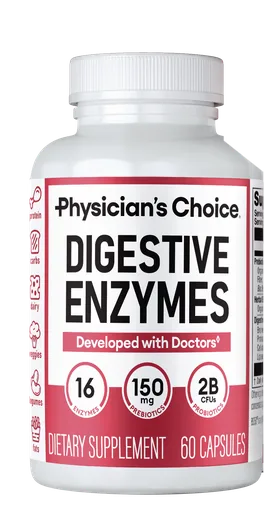
Digestive Enzymes, from the label
Digestive Enzymes is a broad-spectrum blend designed to be taken with meals to help break down proteins, fats, dairy, and carbohydrates.‡
- Enzyme blend
- 85 mg blend of 16 enzymes, including lactase and alpha-galactosidase
- Serving
- 1 capsule; 60 servings in the 60 count bottle
Checked against the product page on Oct 15, 2026. No study or source on this page tested this product.
Which enzyme matches which food, and what the trials measured, are in what supplement helps with gas and bloating after eating? and do digestive enzymes help with bloating?
The answer, in short
Being gassy usually comes down to swallowed air, and to gut bacteria fermenting carbohydrates from foods such as beans, dairy, some fruits, sugar-free sweeteners and whole grains. Passing gas many times a day is normal, and gas from a new food often settles as your gut adjusts. Gas that troubles you, shifts suddenly, or brings pain or blood with it is a reason to see a doctor.
Page history
| Date | Step | What we did |
|---|---|---|
| Sep 12 to Oct 12, 2026 | Shopper words | Read 1,145 public Reddit posts from 250 communities; 258 were about gas and burping. One read, word for word: "since then I've been SO gassy/rumbly" (r/GutHealth, Oct 2026, a question, not a review). |
| Oct 15, 2026 | The question | "Why am I so gassy?", with the follow-ups people add: what causes excessive gas, which foods, and when to see a doctor. Search and AI answers to it cite health agencies and hospitals, and most stop at a list of foods; this page adds what in each food makes the gas. |
| Oct 15, 2026 | Sources | Opened 14 outside sources: three NIDDK pages, MedlinePlus, three Mayo Clinic pages, three Cleveland Clinic articles, Harvard Health, the NHS and two PubMed records. Quotes are copied from each page. |
| Oct 15, 2026 | Label | Checked two Digestive Enzymes lines against the product page. The two lines marked ‡ and the quoted pregnancy line are wording Physician's Choice approved. |
| Oct 15, 2026 | Published | Published by the Physician's Choice editorial team. Each later recheck gets a dated row. |
| Oct 16, 2026 | Update | Linked our new answers on FODMAPs and on tea for bloating. |
Questions about gas
Why am I so gassy all of a sudden?
Usually something changed: more fiber or beans than before, a new way of eating, more sugar-free foods, or a medicine such as an antibiotic, MedlinePlus and Cleveland Clinic say. Gas from a new food often eases as your gut adjusts. A sudden change you cannot explain, or one with belly pain, needs a doctor, per NIDDK.
Is it normal to pass gas 20 times a day?
Yes, by the sources on this page. NIDDK puts the average at 8 to 14 times a day and calls up to 25 normal, and Mayo Clinic and Cleveland Clinic say most people pass gas up to 20 times a day. A change from your own usual pattern, or gas that comes with pain, matters more than the count.
Why do beans make me so gassy?
Beans carry raffinose, a carbohydrate that is hard to digest, along with fiber, so bacteria in the large intestine break them down and make gas, Cleveland Clinic explains. In three feeding studies, fewer than half of adults reported more gas from pinto or baked beans in the first week, and 19% did with black-eyed peas.
What foods cause the most gas?
No source on this page ranks foods by the amount of gas. The ones named most often are beans and lentils, broccoli, cabbage and cauliflower, milk and other dairy foods, apples, pears and peaches, whole grains and bran, sugar-free foods with sorbitol or xylitol, and fizzy drinks, per NIDDK, Mayo Clinic and Cleveland Clinic.
Can too much gas be a sign of something serious?
Usually not. Mayo Clinic says intestinal gas by itself rarely means there is a serious condition. It also says to see your provider if your gas is severe or does not go away, or if it comes with vomiting, diarrhea, constipation or blood in your stool. NIDDK adds belly pain and symptoms that change suddenly.
More answers on this site
- How long does bloating last? What ends it, cause by cause, and when to see a doctorHow long each cause lasts, and what ends it.
- What is a FODMAP? The low-FODMAP diet and bloating, food by foodThe diet that tests these foods group by group.
- Tea for bloating: peppermint, ginger, fennel and what each was tested forWhat the herb studies tested.
- What causes bloating? Common causes and the clue for eachWhen the problem is fullness rather than gas.
- How to keep a food diary for bloating: what to log and how to read itFind your own trigger foods.
- What supplement helps with gas and bloating after eating?The enzyme that matches each food.
- Over-the-counter bloating relief: what each option doesWhat is on the pharmacy shelf.
- Do digestive enzymes help with bloating? What studies tested, and what is still unknownWhat the enzyme trials measured.
- Digestive enzymes side effects: are they safe to take every day?Cautions, source by source.
Sources
- NIDDK: Symptoms and causes of gas in the digestive tractLast reviewed June 2021. Opened Oct 15, 2026.
- NIDDK: Eating, diet and nutrition for gas in the digestive tractLast reviewed June 2021. Opened Oct 15, 2026.
- NIDDK: Symptoms and causes of lactose intoleranceLast reviewed February 2018. Opened Oct 15, 2026.
- MedlinePlus Medical Encyclopedia: Gas, flatulenceReview date 4/27/2026. Opened Oct 15, 2026.
- Mayo Clinic: Gas and gas pains, symptoms and causesBy Mayo Clinic Staff. Opened Oct 15, 2026 through a text reader (direct fetch blocked).
- Mayo Clinic: Belching, gas and bloating, tips for reducing themBy Mayo Clinic Staff, Jan 30, 2024. Opened Oct 15, 2026 through a text reader (direct fetch blocked).
- Mayo Clinic: Intestinal gas, causesJuly 11, 2023. Opened Oct 15, 2026 through a text reader (direct fetch blocked).
- Cleveland Clinic Health Essentials: Gassy all the time? Here's why you might be farting so muchWith gastroenterologist Christine Lee, MD. Published Sep 8, 2026. Opened Oct 15, 2026.
- Cleveland Clinic Health Essentials: Why beans make you burst with gasWith integrative medicine physician Irina Todorov, MD. Published Apr 18, 2023. Opened Oct 15, 2026.
- Cleveland Clinic Health Essentials: Gassier at night? Here's whyWith gastroenterologist Michael Cline, DO. Published Jul 25, 2025. Opened Oct 15, 2026.
- Harvard Health Publishing: Feeling gassy, is it ever a cause for concern?Sep 9, 2019. Opened Oct 15, 2026.
- NHS: Farting (flatulence)Page last reviewed 2 April 2026. Opened Oct 15, 2026.
- Tomlin J, Lowis C, Read NW. Investigation of normal flatus production in healthy volunteers. Gut. 1991;32(6):665-9PubMed 1648028. Abstract read Oct 15, 2026.
- Winham DM, Hutchins AM. Perceptions of flatulence from bean consumption among adults in 3 feeding studies. Nutr J. 2011;10:128PubMed 22104320. Abstract read Oct 15, 2026.
- Physician's Choice: Digestive Enzymes product pageLabel lines checked Oct 15, 2026.