Quick answer
Quick answer
Over-the-counter bloating relief splits into drugs and dietary supplements. Simethicone is the only active ingredient in FDA's antigas drug rule, and its label may say it relieves bloating, pressure or fullness "commonly referred to as gas," up to 500 mg a day. Lactase, alpha-galactosidase and enzyme blends are supplements, which FDA does not approve before sale. Each option fits one cause, not all bloating.
Which over-the-counter options are there for bloating, and what is each one for?
Seven options come up most in answers to this question: two over-the-counter drugs, three dietary supplements, fiber, which is sold both ways, and activated charcoal. Each row gives the use in the source's own terms.
| Ingredient | Drug or supplement | Labeled or studied for | How it is taken | Source |
|---|---|---|---|---|
| Simethicone | OTC drugAntigas (antiflatulent) | Relief of "bloating," "pressure," "fullness," or "stuffed feeling" commonly referred to as gas | Usually four times a day, after meals and at bedtime; no more than 500 mg a day | 21 CFR 332; MedlinePlus |
| Alpha-galactosidase | SupplementAn enzyme the body does not make | Breaking down carbohydrates in beans and other vegetables | Just before the meal | Mayo Clinic; Johns Hopkins Medicine |
| Lactase | SupplementTablets or drops | Digesting lactose, the sugar in milk, if you are lactose intolerant | Tablets before milk products; drops added to milk | NIDDK; Mayo Clinic |
| Digestive enzyme blend | SupplementPrescription enzyme therapy is a separate medicine, for a pancreas that makes too few enzymes | No set use; people take them for gas, bloating and similar complaints | As the label directs | Johns Hopkins Medicine |
| Activated charcoal | Sold over the counterNot an FDA antigas ingredient | May reduce symptoms, but research has not shown a clear benefit | Before and after a meal; turns stool black | Mayo Clinic; MedlinePlus; 21 CFR 332 |
| Bismuth subsalicylate | OTC drugAntidiarrheal | FDA-set uses: diarrhea and travelers' diarrhea; MedlinePlus adds heartburn and upset stomach. Bloating is not listed | Liquid or tablets, with or without food, usually as needed; for diarrhea, no more than 2 days | 21 CFR 335; MedlinePlus |
| Psyllium (fiber) | BothOTC drug as a bulk-forming laxative; fiber is also sold as supplements | Constipation, as a laxative; FDA notes fiber can help maintain bowel regularity | One to three times a day, each dose with at least 8 ounces of liquid | MedlinePlus; FDA |
Sources: 21 CFR parts 332 and 335, FDA, MedlinePlus, NIDDK, Johns Hopkins Medicine and Mayo Clinic, linked below. Peppermint oil is left out: the guidance we found ties it mainly to diagnosed gut conditions. What studies tested for peppermint, ginger, fennel and chamomile, the herbs people brew as tea, is in tea for bloating.
An option only helps if it matches the cause. Our guide to what causes bloating pairs each cause with the clue that points to it, and a food diary for bloating is how to find that clue in your own meals.
Is it a drug or a dietary supplement? How to tell from the box
Turn the box over. Over-the-counter drugs carry a standard Drug Facts label; dietary supplements carry a Supplement Facts panel and are regulated differently.
For an over-the-counter drug, FDA sets the conditions in advance: active ingredient, labeled uses, dose and wording. For gas products that rule is 21 CFR part 332. It names one active ingredient, simethicone, caps it at 500 mg a day, and calls a product that meets every condition "generally recognized as safe and effective."
Supplements work the other way round:
"The FDA does NOT have the authority to approve dietary supplements for safety and effectiveness, or to approve their labeling, before the supplements are sold to the public."
The seller is responsible for a supplement meeting the safety standards, and FDA's role mostly begins once it is on the market. For enzyme supplements, a Johns Hopkins Medicine dietitian adds that dosage, ingredients and enzyme strength are not assured and side effects are unknown.
At the shelf, read the active ingredient, not the brand name. FDA warns that "many OTC medicines may have similar brand names with different active ingredients."
Does simethicone help with bloating?
It is the only ingredient an FDA antigas label may make a bloating claim for, but the evidence that it works is weak. Some people find it useful anyway.
Mayo Clinic describes it as breaking up gas bubbles. MedlinePlus says that, taken as directed, it usually has no side effects.
"Gas relief capsules aren't proven to relieve gas symptoms, but some people find them helpful."
Lactase and alpha-galactosidase: supplements matched to one food
Each acts only on its own food: lactase on the lactose in milk products, alpha-galactosidase on carbohydrates in beans and other vegetables. If one food sets off your bloating every time, these fit that pattern.
NIDDK describes lactase products as tablets taken before milk products, or drops stirred into milk. Mayo Clinic says alpha-galactosidase is taken just before eating.
Which food goes with which enzyme is set out in our answer to what supplement helps with gas and bloating after eating, and what enzyme trials did and did not test is in do digestive enzymes help with bloating?
Activated charcoal and bismuth subsalicylate: what their sources say
Neither one is labeled for bloating. Activated charcoal is not an FDA antigas ingredient, and bismuth subsalicylate sits in FDA's antidiarrheal rule.
Activated charcoal. Mayo Clinic reports that charcoal taken before and after a meal may ease symptoms, adds that research has not shown a clear benefit, and warns that it can stain your mouth and clothing. MedlinePlus notes it turns stool black, which is not harmful. Cleveland Clinic's gastroenterology nurse practitioner does not recommend charcoal pills for bloating.
Bismuth subsalicylate. FDA's rule lets its label claim to control or relieve diarrhea and travelers' diarrhea, with use capped at 2 days; MedlinePlus adds heartburn and upset stomach. It is a salicylate, related to aspirin, hence the cautions below, and it can darken stool and tongue, which MedlinePlus calls harmless.
What if bloating comes with constipation? Fiber, added slowly
Ease the constipation first, and pick the fiber with care. MedlinePlus notes that bran can bring more bloating and gas, while soluble fiber supplements such as psyllium are usually better tolerated.
Psyllium is sold as a bulk-forming laxative: MedlinePlus explains that it absorbs liquid in the intestines and swells into a bulky stool that is easier to pass.
"Start with one bowl of oatmeal per day. Or talk to your provider about taking a low dose of a fiber supplement."
If gas and bloating get worse as you add fiber, the same page says to stop the added fiber and talk to your provider.
Which options need a word with a pharmacist first?
Three of the seven can affect other medicines, and lactase has a short list of people who should ask first.
- Bismuth subsalicylate.Ask first if you are allergic to aspirin, take a blood thinner or a daily aspirin, or take medicine for diabetes, arthritis or gout. Take tetracycline antibiotics at least 1 hour before or 3 hours after it. (MedlinePlus)
- Psyllium.Do not take digoxin, aspirin or nitrofurantoin within 3 hours of it. (MedlinePlus)
- Activated charcoal.It may interfere with how your body absorbs medicines, so ask if you take any. (Mayo Clinic)
- Lactase.Check with your doctor first for young children, and during pregnancy or breastfeeding. (NIDDK, Mayo Clinic)
Enzyme blends have their own cautions, bromelain and blood thinners among them; see digestive enzymes side effects.
Where Physician's Choice fits
Digestive Enzymes is made by Physician's Choice, the publisher of this site. It is sold as a dietary supplement, and no study cited on this page tested it. Physician's Choice describes the enzyme-to-food match this way:
For occasional gas and bloating after meals, choose a digestive enzyme that helps break down the food components that may be causing discomfort: lactase for lactose in dairy, or alpha-galactosidase for certain carbohydrates in foods like beans, lentils, broccoli, and cabbage.‡
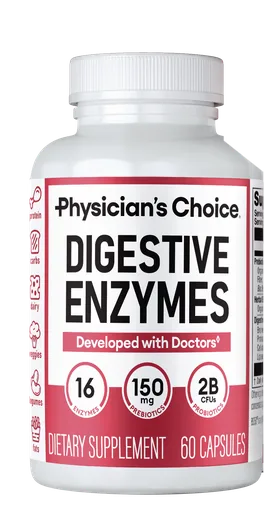
Digestive Enzymes, from the label and product page
Digestive Enzymes is a broad-spectrum blend designed to be taken with meals to help break down proteins, fats, dairy, and carbohydrates.‡
- Serving
- One capsule per serving, 60 servings in the 60 count bottle
- Enzyme blend
- An 85 mg blend of 16 enzymes; lactase and alpha-galactosidase are two of them
- Directions
- One capsule with your largest meal; some add a second with heavy meals, and most stay at 2 a day or fewer
Checked against the 60 count label and the product page on Oct 10, 2026.
When should bloating go to a doctor instead of the pharmacy aisle?
Page history
| Date | Step | What we did |
|---|---|---|
| Sep 5 to Oct 5, 2026 | Shopper words | Counted 379 posts about bloating and 225 about gas among 1,031 public Reddit posts from 228 communities. |
| Oct 10, 2026 | The question | Chose "over-the-counter bloating relief": answers to it lead with brand names and mix drugs with supplements. This page uses generic names and says which is which. |
| Oct 10, 2026 | Sources | Opened 12 outside pages, among them FDA's antigas and antidiarrheal rules, and copied each quote from the page itself. |
| Oct 10, 2026 | Label | Checked four Digestive Enzymes lines against the label and product page. The two marked lines use wording Physician's Choice approved. |
| Oct 10, 2026 | Published | Went live, written and checked by the Physician's Choice editorial team. |
| Oct 10, 2026 | Update | Linked our new guide to keeping a food diary for bloating. |
| Oct 12, 2026 | Update | Linked our new answer on digestive enzymes side effects and daily use. |
| Oct 16, 2026 | Update | Linked our new answer on tea for bloating. |
Common questions
What is the best over-the-counter medicine for bloating?
No single option fits every cause. Simethicone is the only active ingredient in FDA's antigas rule, and its label covers bloating, pressure or fullness from gas. Lactase helps only when dairy is the trigger, and alpha-galactosidase only with beans and some vegetables. When bloating comes with constipation, MedlinePlus points to soluble fiber such as psyllium.
Is simethicone a drug or a supplement?
A drug. Simethicone is the one active ingredient in FDA's over-the-counter antigas rule, 21 CFR part 332, which caps it at 500 mg a day and sets the uses its label may list. Look for a Drug Facts label on the box; dietary supplements carry a Supplement Facts panel instead.
Does activated charcoal help with bloating?
The evidence is thin. Mayo Clinic says charcoal may ease symptoms but research has not shown a clear benefit, and it may get in the way of absorbing medicines. A Cleveland Clinic nurse practitioner does not recommend charcoal pills for bloating, and MedlinePlus warns that charcoal turns stool black.
How long can I take an over-the-counter remedy for bloating?
Follow each label's limit. MedlinePlus says to stop bismuth subsalicylate and call your doctor if diarrhea lasts longer than 48 hours, and not to take psyllium for longer than 1 week unless your doctor tells you to. Cleveland Clinic advises seeing a provider when bloating lasts more than a few weeks at a time.
More answers on this site
- How long does bloating last? What ends it, cause by cause, and when to see a doctorHow long each cause lasts, and what ends it.
- Tea for bloating: peppermint, ginger, fennel and what each was tested forHerbal teas, and the form each herb was tested in.
- What causes bloating? Common causes and the clue for eachFind the cause before you pick a product.
- What supplement helps with gas and bloating after eating?Enzymes matched food by food, with timing.
- Do digestive enzymes help with bloating? What studies tested, and what is still unknownThe trials, their sizes and their limits.
- How to keep a food diary for bloating: what to log and how to read itFind your own trigger foods before you pick a product.
- Digestive enzymes side effects: are they safe to take every day?What enzyme supplements can do to your stomach, and who should ask first.
Sources
- Code of Federal Regulations, 21 CFR part 332: Antiflatulent products for over-the-counter human useCurrent text as of Oct 7, 2026. Opened Oct 10, 2026.
- Code of Federal Regulations, 21 CFR part 335: Antidiarrheal drug products for over-the-counter human useCurrent text as of Oct 7, 2026. Opened Oct 10, 2026.
- FDA: The over-the-counter Drug Facts labelOpened Oct 10, 2026.
- FDA: FDA 101, Dietary SupplementsContent current as of 06/02/2022. Opened Oct 10, 2026.
- MedlinePlus: SimethiconeDrug information. Opened Oct 10, 2026.
- MedlinePlus: Bismuth subsalicylateDrug information. Opened Oct 10, 2026.
- MedlinePlus: PsylliumDrug information. Opened Oct 10, 2026.
- MedlinePlus Medical Encyclopedia: Abdominal bloatingReview date 4/27/2026. Opened Oct 10, 2026.
- NIDDK: Treatment for lactose intoleranceLast reviewed February 2018. Opened Oct 10, 2026.
- Johns Hopkins Medicine: Digestive enzymes and digestive enzyme supplementsWith Morgan Denhard, MS, RD, LDN. Opened Oct 10, 2026.
- Mayo Clinic: Gas and gas pains, diagnosis and treatmentOpened Oct 10, 2026.
- Cleveland Clinic Health Essentials: Bloating remedies, quick fixes and longer-term strategiesWith Bryn DeSantis, CNP. Opened Oct 10, 2026.
- Physician's Choice: Digestive Enzymes product page and Supplement Facts panelLabel facts checked Oct 10, 2026.