Quick answer
Quick answer
Bloating is a feeling of fullness or swelling in the belly; distention is when the belly becomes larger than usual, NIDDK says. Most bloating comes from gas, from swallowed air or from bacteria breaking down carbohydrates your small intestine did not fully digest. Constipation, lactose intolerance, large or rushed meals and period hormone shifts are other common causes on NIDDK, Cleveland Clinic and NHS lists. Timing is the clue.
What is bloating, and how is it different from distention?
Bloating is a feeling; distention is a visible change. NIDDK defines bloating as a feeling of fullness or swelling in your abdomen, and uses distention for a belly that has become larger than usual.
The two often show up together, but not always. NIDDK notes that only about half of people with bloating also have distention, and that some people feel discomfort or pain along with it. Cleveland Clinic describes the sensation as tightness, pressure or fullness that ranges from mildly uncomfortable to intensely painful, and says it usually goes away after a while.
"Having some gas symptoms is normal, especially during or after meals."
What are the common causes of bloating? The clue for each
Gas sits behind most of them. The table lists the causes that NIDDK, Cleveland Clinic, Mayo Clinic, MedlinePlus and the NHS name most often, and the pattern that tends to point to each one.
| Cause | The clue | First step | Named by |
|---|---|---|---|
| Swallowed air | Worse with gum, hard candy, fizzy drinks, smoking or eating fast; often comes with burping | Slow down at meals; drop gum and straws | NIDDK |
| Foods your gut ferments | After beans, lentils, cabbage, onions or whole grains, with more gas than usual | Smaller portions of the foods that bother you; a food diary | MedlinePlus, Mayo Clinic |
| Sugar-free sweeteners | After sugar-free gum, candy or drinks made with sorbitol, mannitol or xylitol | Check ingredient lists for these sweeteners | Mayo Clinic, MedlinePlus |
| A fast jump in fiber | Began when you added fiber, and often fades once gut bacteria adjust | Add fiber gradually over a few weeks | MedlinePlus |
| Eating too much, too fast | Right after a large meal, whatever the food | Smaller meals, eaten slowly | Cleveland Clinic, MedlinePlus |
| Lactose intolerance | Within a few hours of milk products, sometimes with diarrhea or stomach rumbling | Track dairy in your diary; a doctor can confirm it | NIDDK, MedlinePlus |
| Constipation | Fewer than three bowel movements a week, or hard, dry stools; gas is harder to pass | Fiber, fluids and movement; a doctor if it does not ease | NIDDK, Mayo Clinic |
| Period and hormone changes | Around your period, in pregnancy or in perimenopause | Note bloating days against your cycle | NHS, Cleveland Clinic |
| Celiac disease | Bloating with ongoing diarrhea or loose, greasy stools; symptoms alone cannot confirm it | Get tested before you cut out gluten | NIDDK, Mayo Clinic, MedlinePlus |
| A sensitive gut | Feeling gassy and bloated even when the amount of gas is normal | A doctor's view, with your diary | Cleveland Clinic, NIDDK |
Sources: NIDDK, Cleveland Clinic, Mayo Clinic, MedlinePlus and the NHS. Links below. A clue points to a likely cause; only a doctor can confirm a condition.
Each food row has its own entry, with a line from NIDDK, in our food by food list. When the trouble is gas itself rather than fullness, what in each food makes the gas is set out in why am I so gassy? Once you have a likely cause, over-the-counter bloating relief sets out what each product on the shelf is labeled for, and which are drugs and which are supplements.
Why do I bloat after eating?
Usually because of gas from the meal itself: air swallowed while you eat, or carbohydrates that reach the large intestine undigested. How soon the bloating starts is a useful clue.
| When it starts | Likely cause | What it points to | Named by |
|---|---|---|---|
| During or right after the meal | Swallowed air, or eating too much, too fast | How you eat: speed, portion size, gum, hard candy and fizzy drinks | NIDDK, Mayo Clinic, Cleveland Clinic |
| Later, once food reaches the large intestine | Gut bacteria breaking down carbohydrates that were not fully digested | What you ate: beans, lentils, cabbage, onions, whole grains or sugar-free sweeteners | NIDDK, MedlinePlus, Mayo Clinic |
| Within a few hours of milk products | Lactose intolerance: low lactase lets undigested lactose reach the colon | Dairy: track it in your diary, and a doctor can confirm it | NIDDK |
Sources: NIDDK, Mayo Clinic, Cleveland Clinic and MedlinePlus. NIDDK and Mayo Clinic both call some gas during or right after a meal normal. Mayo Clinic adds that fiber, though it adds gas, is essential for keeping your digestive tract in good working order.
Onset is half of the clue. How long each kind of bloating lasts, and what ends it, is in how long does bloating last?
People ask about this in plain terms. Of 1,031 public Reddit posts we read for this site between September 5 and October 5, 2026, 379 were about bloating, and seven described a belly that looks pregnant after an ordinary meal.
How do you find your own cause? A food and symptom diary
Write down what you eat and drink, and when the bloating starts. NIDDK says a doctor may ask for exactly this kind of diary, because it can show which foods and drinks are causing gas.
- What you ate and drank, with the time.Include drinks, gum and anything sugar-free.
- When the bloating started and how long it lasted.During the meal and hours after it point to different rows of the timing table above.
- How you ate.Fast, on the move, through a straw, or while talking: each adds swallowed air, per NIDDK.
- Bowel movements.How often you went and what the stools were like, since constipation is on every list.
- Your cycle, if you have one.The NHS notes that some people feel bloated around the time of their period.
- Medicines and supplements.NIDDK lists both among the things a doctor asks about.
"Reviewing your diary may also help your doctor find out if you have excess gas or are more sensitive to normal amounts of gas."
A template to copy, and a table for reading the entries once you have them, are in our guide to keeping a food diary for bloating.
Where Physician's Choice fits
Physician's Choice, which publishes this site, makes Digestive Enzymes. An enzyme acts on the food in the meal it is taken with, so it is only relevant when a specific food is the trigger, not for the other causes above. Physician's Choice puts it this way:
For occasional gas and bloating after meals, choose a digestive enzyme that helps break down the food components that may be causing discomfort: lactase for lactose in dairy, or alpha-galactosidase for certain carbohydrates in foods like beans, lentils, broccoli, and cabbage.‡
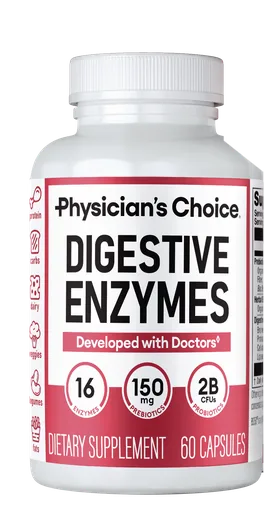
Digestive Enzymes at a glance
Digestive Enzymes is a broad-spectrum blend designed to be taken with meals to help break down proteins, fats, dairy, and carbohydrates.‡
- Serving
- 1 capsule; 60 servings per bottle
- Enzyme blend
- 85 mg, 16 enzymes, lactase and alpha-galactosidase among them
- Directions
- 1 capsule with your largest meal; some people take an extra one with heavy meals, and most do not take more than 2 a day
Serving and blend checked against the 60 count label, directions against the product page, on Oct 9, 2026. No study on this page tested it.
For the enzyme that matches each food, see the Physician's Choice table Bloating after meals: match the enzyme to the food. Our answer to what supplement helps with gas and bloating after eating compares lactase, alpha-galactosidase, simethicone and probiotics, and do digestive enzymes help with bloating? covers what the trials measured. Side effects and daily use are in digestive enzymes side effects.
When is bloating a reason to see a doctor?
Page history
| Date | Step | What we did |
|---|---|---|
| Sep 5 to Oct 5, 2026 | Shopper words | Read 1,031 public Reddit posts from 228 communities. 379 were about bloating; seven described looking pregnant after an ordinary meal. |
| Oct 9, 2026 | The question | Chose "what causes bloating?" because search engines and AI answer engines both answer it, and most answers stop at a list. This page adds the clue for each cause. |
| Oct 9, 2026 | Sources | Opened 11 outside pages from NIDDK, Cleveland Clinic, Mayo Clinic, MedlinePlus and the NHS, and copied each quote from the page itself. |
| Oct 9, 2026 | Label | Checked three Digestive Enzymes label lines against the panel. The two product sentences marked with a symbol use wording approved by Physician's Choice. |
| Oct 9, 2026 | Published | Published by the Physician's Choice editorial team. Each later recheck gets a dated row. |
| Oct 10, 2026 | Update | Linked our new answer on over-the-counter bloating relief. |
| Oct 10, 2026 | Update | Linked our new guide to keeping a food diary for bloating. |
| Oct 12, 2026 | Update | Linked our new answer on digestive enzymes side effects and daily use. |
| Oct 15, 2026 | Update | Linked our new answer on why you may be so gassy. |
| Oct 18, 2026 | Update | Linked our new answer on how long bloating lasts. |
People also ask
What is the most common cause of bloating?
Gas. Cleveland Clinic calls excess gas the most common cause of a bloated stomach, and the NHS says the most common reason is a lot of gas in your gut. That gas comes from air you swallow and from gut bacteria breaking down carbohydrates that were not fully digested higher up.
Why do I feel bloated after every meal?
Each meal brings some swallowed air and some carbohydrates that reach the large intestine undigested, where bacteria turn them into gas (NIDDK). Eating fast, large portions, fizzy drinks and foods like beans or cabbage add to it. Bloating that lasts more than a week or is very painful needs a provider (Cleveland Clinic).
Can your period make you bloated?
Yes. The NHS says some people feel bloated around the time of their period. Cleveland Clinic says bloating is also common in pregnancy and during the hormone shifts of perimenopause, partly because estrogen causes water retention. Marking your cycle in a symptom diary shows whether the timing lines up.
When should I worry about bloating?
See a provider if it lasts more than a week, is very painful, or comes with fever, vomiting, bleeding, weakness or an unexplained change in your weight (Cleveland Clinic). NIDDK adds sudden changes, belly pain, constipation or diarrhea. The NHS says bloating that does not go away can sometimes signal something more serious.
Sources
- NIDDK: Symptoms and causes of gas in the digestive tractLast reviewed June 2021. Opened Oct 9, 2026.
- NIDDK: Diagnosis of gas in the digestive tractOpened Oct 9, 2026.
- NIDDK: Symptoms and causes of lactose intoleranceLast reviewed February 2018. Opened Oct 9, 2026.
- NIDDK: Symptoms and causes of constipationLast reviewed May 2018. Opened Oct 9, 2026.
- NIDDK: Symptoms and causes of celiac diseaseLast reviewed October 2020. Opened Oct 9, 2026.
- NIDDK: Diagnosis of celiac diseaseLast reviewed October 2020. Opened Oct 9, 2026.
- Cleveland Clinic: Bloating, what it is, causes and when to be concernedMedically reviewed, last updated May 4, 2026. Opened Oct 9, 2026.
- Mayo Clinic: Gas and gas pains, symptoms and causesBy Mayo Clinic Staff, Sep 20, 2025. Opened Oct 9, 2026.
- MedlinePlus Medical Encyclopedia: Abdominal bloatingReview date 4/27/2026. Opened Oct 9, 2026.
- MedlinePlus Medical Encyclopedia: FiberReview date 7/22/2026. Opened Oct 9, 2026.
- NHS: BloatingPage last reviewed 21 January 2026. Opened Oct 9, 2026.
- Physician's Choice: Digestive Enzymes product page and Supplement Facts panelLabel facts checked Oct 9, 2026.