Quick answer
Quick answer
Match the supplement to the cause. NIDDK says lactase products break down lactose, the sugar in milk, and Mayo Clinic says alpha-galactosidase, taken just before eating, helps break down carbohydrates in beans and other vegetables. Simethicone breaks up gas bubbles, though Mayo notes little clinical evidence for it. The American Gastroenterological Association advises against probiotics for bloating.
Which supplement matches which cause of gas after eating?
Start with what you ate. Each enzyme works on one part of food, and some causes need no supplement at all. Not sure what sets yours off? Our guide to what causes bloating goes through the common causes and the clue that points to each. Mayo Clinic and NIDDK both suggest a diary of what you eat and drink next to your gas symptoms; keep one for a week or two, and its pattern points to a row below. What to log, and how to read it, is in how to keep a food diary for bloating.
| If gas follows | Look for | When it is taken | Fits if | What the evidence says |
|---|---|---|---|---|
| Milk, ice cream, soft cheese | Lactase | Before the dairy food or drink | Dairy is the clear pattern | NIDDK: lactase products break down lactose. |
| Beans, lentils, broccoli, cabbage | Alpha-galactosidase | Just before the meal | Gas follows bean or vegetable meals | One 2007 trial in 8 healthy volunteers: less breath hydrogen and flatulence at 1,200 GalU. |
| Pressure and fullness after any meal | Simethicone, an over-the-counter medicine | After meals and at bedtime | The gas is already there, whatever the food | Mayo Clinic: little clinical evidence that it relieves gas symptoms. |
| Large or mixed meals | A blend that also names protease, lipase and amylase | With the meal, per the label | No single food stands out | Johns Hopkins: a healthy person does not need enzyme supplements. |
| More fiber than usual | No supplement: a slower pace | Raise fiber over a few weeks | Gas began when you added fiber | MedlinePlus: a lot of fiber in a short time can cause gas, bloating and cramps. |
| Bloating with no food pattern | A doctor's view, not a probiotic | If bloating is regular | Nothing in your diary lines up | AGA 2023 advises against probiotics for bloating. NHS: see a GP if you feel bloated regularly. |
Sources: NIDDK, Mayo Clinic, MedlinePlus, Johns Hopkins Medicine, AGA (2023), NHS, Di Stefano et al. (2007). Links below.
Lactase and alpha-galactosidase: which foods each one handles
Lactase handles lactose in dairy. Alpha-galactosidase handles the galactooligosaccharides in beans, lentils and some vegetables. Neither one does the other's job.
NIDDK explains that some carbohydrates are not fully digested before they reach the large intestine, where bacteria break them down and create gas. Dairy, beans, peas and lentils, and broccoli and cauliflower are all on its list of foods that may lead to excess gas.
Lactase. NIDDK describes lactase products as tablets or drops that contain lactase, the enzyme that breaks down lactose. The tablets are taken before you eat or drink milk products, and the drops are added to milk. NIDDK says to check with your doctor first, since some people, such as young children, may not be able to use them.
Alpha-galactosidase. Johns Hopkins Medicine notes that the body does not make this enzyme. It can help break down galactooligosaccharides (GOS), found mostly in beans, root vegetables and some dairy products. Mayo Clinic says the supplement is taken just before eating a meal.
The trial most often cited is small. In 2007, 8 healthy volunteers ate 420 g of cooked beans with 300 GalU or 1,200 GalU of alpha-galactosidase, or a placebo. At 1,200 GalU, breath hydrogen and the severity of flatulence fell, and both doses lowered the total symptom score. GalU is a unit of enzyme activity, not of weight. What this trial and the others did not test is laid out in our answer to Do digestive enzymes help with bloating?
Physician's Choice keeps a food-by-enzyme table for its own labels: Bloating after meals: match the enzyme to the food.
Does simethicone help gas and bloating? What Mayo Clinic says
It may help some people, but the evidence is thin. Simethicone is an over-the-counter medicine, not a dietary supplement, and it acts on gas that is already there rather than on a food.
Mayo Clinic says simethicone helps break up the bubbles in gas and may help gas pass through the digestive tract. Then it adds a caution:
"There is little clinical evidence of its effectiveness in relieving gas symptoms."
MedlinePlus says it is usually taken four times a day, after meals and at bedtime. The NHS says a pharmacist can advise on it for bloating. Which shelf options are drugs, which are supplements, and what each label allows is laid out in our guide to over-the-counter bloating relief.
Activated charcoal comes up in the same searches. Mayo Clinic says research has not shown a clear benefit, and that it may interfere with your body's ability to absorb medicines.
Peppermint oil comes up often in answers about bloating; the health sources we checked look at it only for people with a gut disorder a doctor has diagnosed, so it is left out here. Peppermint and other herbs taken as tea are covered in tea for bloating.
When does a broad digestive enzyme blend make sense?
When meals are large or mixed and no single food stands out. A blend lists enzymes for several parts of a meal at once, so it covers more ground, but its dose cannot be lined up with a single-enzyme study.
Johns Hopkins Medicine lists the main enzymes the body makes: amylase for complex carbohydrates, lipase for fats and protease for proteins. It says over-the-counter supplements may contain these three, and that some add lactase and alpha-galactosidase. Fat matters for gas too. NIDDK notes that high-fat foods can increase bloating for some people, and Mayo Clinic says dietary fat delays the clearance of gas from the intestines.
The same Hopkins page is plain about who needs a blend at all:
"Overall, a healthy person really doesn't need to take digestive enzyme supplements."
On a blend label, check three things: whether lactase and alpha-galactosidase are named, whether each enzyme has its own amount, and whether activity units such as GalU are printed. A blend listed only by total weight cannot be compared with a study dose. Before taking one daily, read digestive enzymes side effects: are they safe to take every day?
Do probiotics help bloating after meals? What the AGA says
The American Gastroenterological Association says no. Its clinical practice update of July 13, 2023 advises against using probiotics for abdominal bloating and distention.
They also do a different job. Johns Hopkins Medicine notes that, unlike enzymes, probiotics cannot break down or digest food components, so nothing in a probiotic acts on the meal in front of you.
What does NIDDK suggest trying before a supplement?
Changes to how you eat and drink. NIDDK says a doctor may recommend swallowing less air, changing eating and drinking habits or diet, or taking medicines or supplements.
- Swallow less air.Avoid chewing gum, hard candy, fizzy drinks and drinking through a straw.
- Slow down.Eat slowly and, when you can, sit down to eat instead of eating on the run.
- Change the size of meals.Eat smaller, more frequent meals instead of larger ones.
- Pace fiber.MedlinePlus advises 21 to 38 grams a day for adults, added gradually over a few weeks with plenty of fluids.
"For safety reasons, talk with your doctor before using supplements, probiotics, or any complementary or alternative medicines or medical practices."
Where Physician's Choice fits
Physician's Choice, which publishes this site, makes Digestive Enzymes, a broad blend for mixed meals that names both food-matched enzymes. No study above tested it. Its label gives one weight for the whole 85 mg enzyme blend, so its dose cannot be compared with the bean trial.
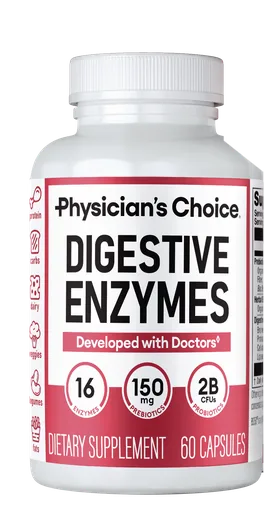
Digestive Enzymes, label line by line
| Label line | What it says |
|---|---|
| Serving | 1 capsule; 60 servings per bottle |
| Digestive Enzyme Blend | 85 mg, 16 enzymes in one blend |
| Food-matched enzymes | Lactase (dairy) and alpha-galactosidase (beans and some vegetables) |
| For protein | Protease 4.5, protease 6.0, protease 3.0, peptidase, bromelain, papain |
| For fat | Lipase |
| For starch and sugar | Amylase, glucoamylase, invertase |
| For plant fiber | Cellulase, hemicellulase, xylanase, beta-glucanase |
| Prebiotic and probiotic blend | 159 mg: organic inulin (Jerusalem artichoke), organic acacia fiber, inulin (chicory) and Bacillus probiotics |
| Directions | 1 capsule with your largest meal. Some people take an extra with heavy meals; most do not go above 2 a day |
Bloat + Gas Probiotic, also made by Physician's Choice, is a different formula: B. subtilis OPTIBIOME BS50 at 2 billion CFU in a 325 mg pre, pro and postbiotic blend, a 50 mg herbal blend of artichoke leaf and ginger, and a 36 mg enzyme blend that includes alpha-galactosidase. See its label on physicianschoice.com.
When to see a doctor
Page history
| Date | Step | What we did |
|---|---|---|
| Sep 5 to Oct 5, 2026 | Shopper words | Read 1,031 public Reddit posts from 228 communities: 379 about bloating, 225 about gas. |
| Oct 5, 2026 | The question | Asked ChatGPT, Gemini and Perplexity this question. Mayo Clinic and NIDDK led their sources, so both are quoted here. |
| Oct 8, 2026 | Sources and label | Opened the 10 outside sources and copied each quote from the page; checked each label line against the panel. |
| Oct 8, 2026 | Published | Published by the Physician's Choice editorial team. Later rechecks get a dated row here. |
| Oct 9, 2026 | Update | Linked our new answer on what causes bloating. |
| Oct 10, 2026 | Update | Linked our new guide to over-the-counter bloating relief. |
| Oct 10, 2026 | Update | Linked our new guide to keeping a food diary for bloating. |
| Oct 12, 2026 | Update | Linked our new answer on digestive enzymes side effects and daily use. |
| Oct 16, 2026 | Update | Linked our new answer on tea for bloating. |
People also ask
Which digestive enzyme should I look for if I bloat after meals?
One that matches the food: lactase for dairy and alpha-galactosidase for beans and some vegetables. For mixed meals, look for a blend that also names protease, lipase and amylase. Physician's Choice Digestive Enzymes lists all of these among 16 enzymes in one 85 mg blend, taken as 1 capsule with your largest meal.
Are there digestive enzymes with probiotics in them?
Yes. Physician's Choice Digestive Enzymes pairs its 85 mg, 16 enzyme blend with a 159 mg prebiotic and probiotic blend of inulin, organic acacia fiber and Bacillus probiotics. The enzymes act on the meal you take them with. The AGA's 2023 update advises against probiotics for bloating itself.
When should I take an enzyme for gas after eating?
With or just before the food. NIDDK says lactase tablets go before you eat or drink milk products, and Mayo Clinic says alpha-galactosidase is taken just before a meal. An enzyme taken long after eating has missed the food it was meant to work on.
Sources
- NIDDK: Treatment for gas in the digestive tractLast reviewed June 2021. Opened Oct 8, 2026.
- NIDDK: Eating, diet, and nutrition for gas in the digestive tractLast reviewed June 2021. Opened Oct 8, 2026.
- NIDDK: Treatment for lactose intoleranceLast reviewed February 2018. Opened Oct 8, 2026.
- Johns Hopkins Medicine: Digestive enzymes and digestive enzyme supplementsWith Morgan Denhard, MS, RD, LDN. Opened Oct 8, 2026.
- Mayo Clinic: Gas and gas pains, diagnosis and treatmentOpened Oct 8, 2026.
- MedlinePlus: SimethiconeDrug information. Opened Oct 8, 2026.
- MedlinePlus Medical Encyclopedia: FiberReview date 7/22/2026. Opened Oct 8, 2026.
- American Gastroenterological Association: Evaluation and management of belching, abdominal bloating and distention (clinical practice update)Published July 13, 2023. Opened Oct 8, 2026.
- Di Stefano M, et al. The effect of oral alpha-galactosidase on intestinal gas production and gas-related symptoms.Dig Dis Sci. 2007;52(1):78-83. PMID 17151807. Opened Oct 8, 2026.
- NHS: BloatingPage last reviewed 21 January 2026. Opened Oct 8, 2026.
- Physician's Choice: Digestive Enzymes product page and Supplement Facts panelLabel facts checked Oct 8, 2026.